
The Service Stack: What Remains When Client Services Are Being Eaten by AI

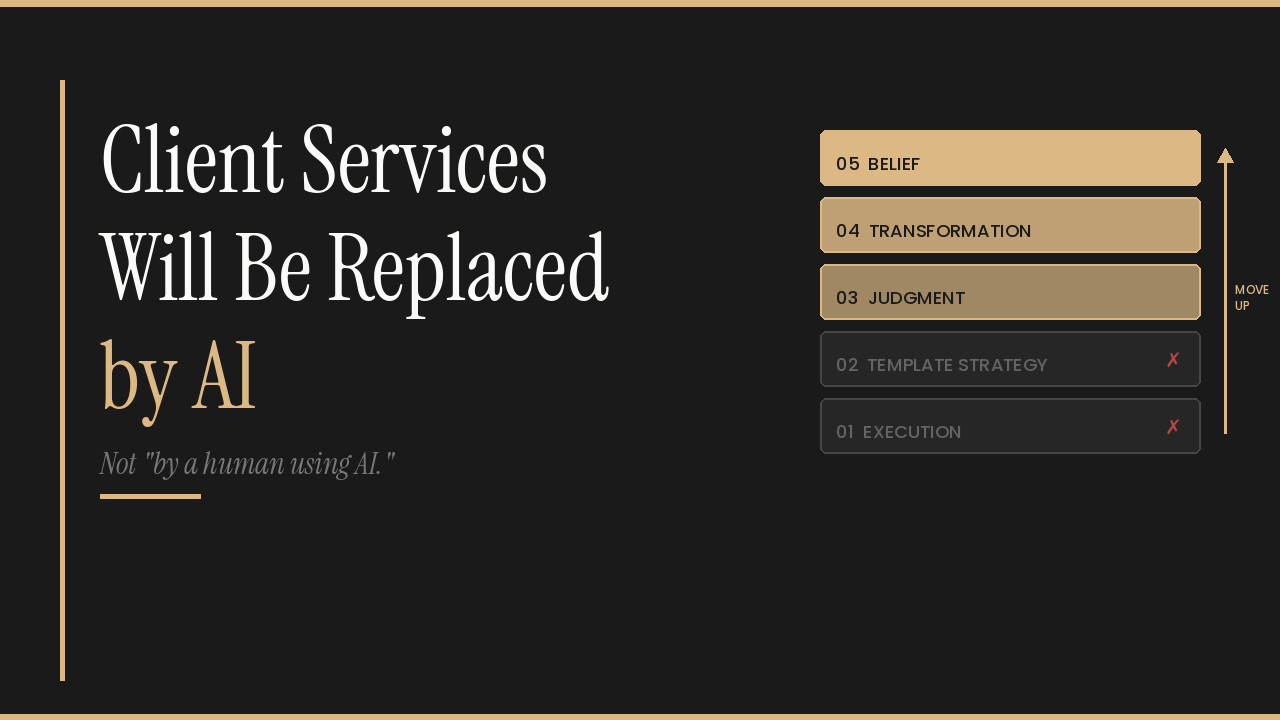
Client services will be replaced by AI.
Not “by a human using AI.”
That’s a cute aphorism people share on LinkedIn to make themselves feel better about what’s coming.
The reality is simpler and little more intense than that. AI will do the work you currently charge for, it will do it faster, it will do it cheaper, and in many cases it will do it better.
I know this because I’m watching it happen in real time with my own work.
I’ve built waterfall agentic workflows for my own internal processes
Workflows for my portfolio of private clients
GTM agents for select clients including publicly traded companies…
And now, I’m training agents to do strategic work that used to take me 3-4 weeks of focused effort…. to complete it in a couple of hours.
The output wasn’t a rough draft or a starting point. It was client presentable. Something I could put in front of a CEO if I wanted to.
In the past AI would enable me to do more in my 3-4 week strategy sprints with clients. Same time investment but it allowed me to go further.
Now, I’m able to capture that value in days and (maybe even) hours.
And this isn’t cookie cutter strategy.
I’ve written books, created literally several hundreds of templates, dozens of frameworks, and honed in my IP for this strategy work. And trained AI on the frameworks that produce real world results for clients.
As I sat there looking at the finished product and I felt both excited and perplexed.
Because if AI just did in hours what I used to do for weeks (obvious with unique training) it begs the questions:
how do I package what I do in the new era of value creation?
is the market even ready for what’s about to hit?
Are YOU ready for the seismic shift?
Those questions is the reason I’m writing this.
Client Services Is About to Get Compressed
If you sell client services of any kind, whether you run an agency, a consultancy, a coaching practice, or a solo operation, you’re sitting on top of a structure that’s about to get compressed from the bottom up. Most people in the industry can feel it but they don’t have language for what’s actually happening.
If you want to see what this compression looks like in real time, look at what just happened to SaaS. In late Jan 2026, Anthropic released 11 plugins for Claude that automate workflows across legal, sales, marketing, and data analysis. The market response was immediate. $285 billion in software stock value disappeared in a single trading session. Thomson Reuters had its biggest single day drop in company history. Salesforce fell 7%. LegalZoom dropped 20%. The event got its own name: the SaaSpocalypse.
What actually happened?
A foundation model company moved up the stack.
Instead of selling API access and letting other companies build products on top, Anthropic shipped complete workflows directly to end users. The entire middle layer of software that existed between the AI and the person using it got compressed overnight.
Satya Nadella himself warned about this. He said business applications “will all collapse in the agent era” because they’re essentially databases with business logic, and the business logic is moving to agents.
Now apply that same pattern to client services.
The same compression that just hit SaaS is coming for every agency, consultancy, and client service business that sits between AI capability and the client who needs the outcome.
So here’s the framework I’ve been developing. I call it the Service Stack because it maps almost perfectly to how the tech world thinks about AI infrastructure.
In tech you have layers.
Data infrastructure at the foundation
the models built on that data
the tooling and applications built on those models
the interface the end user actually touches
Each layer builds on the one below it. The higher you go, the closer you get to the human, and the harder you are to replace.
Client services work the exact same way. And once you see which layer you’re operating on, you can see exactly how exposed you are and exactly where you need to move.
Layer 1: Execution (Already Being Replaced… It’s Only a Matter of Time For Quality to Exponentially Improve)
This is the bottom of the stack. Content production, design assets, social media management, email campaigns, website maintenance, lead generation fulfillment. The deliverables that agencies have been packaging into monthly retainers for the last 20 years.
Think in the future with me:
This layer has already been made obsolete. The market is just processing the transition in slow motion.
I consulted one of the top lead generation agencies in the entire country. They were doing what I call “stamps,” which is essentially the same deliverable customized slightly for each client and repeated at scale across hundreds of accounts. That model worked beautifully when the only way to produce the work was to hire people and build systems/automations.
But when AI can produce the same output at a fraction of the cost with better consistency, the economics break.
If you’re running an agency that charges $5 - $15K a month for social media management, email campaigns, or content syndication etc- essentially to use Jonathan Stark’s terms: you’re only “selling hands”…
You’re not in a declining business. You’re in a business that’s about to get undercut by a competitor who does what you do at 10x scale for a tenth of the price. And that competitor might be one founder with an AI workflow and zero employees.
Layer 2: Template Strategy (12 to 18 Months as of Early 2026)
This is where it gets personal for a lot of consultants.
Template strategy means taking a framework you learned from a course, a certification, or a book, and applying it to every client with minor customization. Ie:
generic brand audit
cookie cutter messaging framework
marketing plan you could have generated from a fill-in-the-blank template.
To be completely honest with you, this layer is in the same position as execution. It just hasn’t caught up yet.
The time for you to own or develop your IP was yesterday. Now it’s even more critical you develop your own way and method of execution. This isn’t going to save you but will keep you differentiated for the next year or so.
AI runs more thorough competitive audits than most consultants. It generates positioning frameworks and messaging architectures that are technically competent and strategically sound.
If the core of what you sell is a framework applied to someone’s business, AI does that today. The only reason your clients haven’t figured it out yet is they haven’t tried (plus they wont care to look “under the hood”)
Good strategy will win but you have to do more than just have good strategy.
Layer 3: Judgment Driven Strategy (The 2 to 3 Year Window)
Now here’s where I need to make an important distinction because this is the part that most people get wrong when they talk about AI and strategy.
The distinction most people miss is that crappy strategy gets commoditized, but good strategy actually gets amplified (for now)
There’s a massive difference between a consultant who memorized a framework and a consultant who’s spent years in the trenches doing the actual work.
When I build a Growth Plan using AI, I’m not handing the wheel to the machine and hoping for the best. I’m driving the entire time. I’m making judgment calls at every turn because I’ve done this work with enough companies to know what actually moves the needle versus what just looks impressive in a deck.
I reject outputs that are technically correct but practically wrong. I add context about team dynamics, founder psychology, market timing, competitive threats.
The AI doesn’t know that a particular client’s real problem isn’t their offer suite but that their founder is afraid to fire their operations manager because she’s their wife’s best friend. (That example is too close to the truth…)
This layer doesn’t get replaced by AI. It gets accelerated. The experienced operator who uses AI to do in 2 hours what used to take 2 weeks becomes more valuable, not less.
This is worth repeating:
The experienced operator who uses AI to do in 2 hours what used to take 2 weeks becomes more valuable, not less.
Why? Because of the net new value you will identify and be able to act on that you otherwise wouldn’t see if your still doing things by hand…
Your margins go up because your cost of delivery drops toward zero while the judgment, the actual thing the client is paying for, stays the same or improves with each engagement.
But I want to be honest about the window here. AI reasoning is getting better on a curve measured in months. The gap between template strategy and judgment driven strategy is real right now but it is closing.
As of Jan 2026 top engineers at frontier AI labs like Anthropic and OpenAI report that AI writes 100% of their code. Their role has shifted from writing to directing and reviewing.
Therefore the underlying strategy which you execute is important but won’t be the major driver to your success.
Which means you need to be building your position on the layers above this one while you still have the advantage.
I estimate you have about 2 to 3 years of clear runway on this layer (and I’m an optimist). Use them.
Layer 4: Transformation & Accountability (If You Want to Compete, Start Here)
Let me give you an analogy about I think about this entire problem.
Think about the fitness industry.
MyFitnessPal, YouTube, ChatGPT/ai can make your workout plans and the meal plan completely free. Anyone on the planet can get a world class nutrition and training program for net zero dollars right now.
The information barrier doesn’t exist anymore. There is no knowledge gap between someone who pays a trainer and someone who doesn’t.
And yet personal training grew…premium fitness, the $500 per month online coaching tier exploded (personal training hit $42.5 billion in 2024 and is projected to his $60 billion by 2030)
How does that make any sense if the plan itself is free?
Because the constraint was never the plan. The constraint is the human being who needs to follow the plan.
The person who hires a personal trainer doesn’t need someone to tell them to eat more protein and lift heavy 4 times a week.
They need to become someone who actually does that consistently over time.
That’s an identity level transformation.
And identity shifts don’t happen from reading a document or downloading an app. They happen inside a relationship where someone sees you, challenges you, won’t let you off the hook, and holds you accountable to a version of yourself you haven’t become yet.
Your clients work the same way.
Every client who comes to you already kind of knows what they need to do. The work you do for them confirms it and makes it specific. But the distance between “I know I need to restructure my offer suite” and actually restructuring it, actually having the hard conversation with the long standing client who’s on legacy pricing, actually retraining the sales team, actually rebuilding the delivery model from scratch, that distance is where businesses stall out and never reach the next level.
AI makes the knowing part free. You charge for the doing part… not just the “hands”. Let me explaon:
You’re not selling growth plans or strategy decks or brand architectures. You’re selling the closing of the knowing-doing gap.
You’re orchestrating execution, guiding the client through the messy middle where the plan meets reality and breaks, adapting in real time, and staying accountable for the outcome over months, not just the recommendation in a single meeting.
If it works, you’re there to build on it. If it doesn’t work, you’re there next month to figure out why and course correct.
The difference between AI and you in this scenario is that AI gives advice with no consequences, while you make promises with your reputation and your revenue on the line.
That changes how the client receives the recommendation entirely.
Layer 5: Belief (Top of the Stack)
Here’s something I learned from chatting with Tom Ziglar and I don’t hear enough in the marketplace right now…
There’s a layer above transformation and accountability. It’s the most durable position in the entire stack and it’s the reason some consultants and agencies will not just survive AI but come out stronger on the other side.
AI cannot believe in you.
It can encourage you and can affirm you to the point of hallucination. It can simulate empathy convincingly enough to fool you for a while. But it cannot sit across from you and make you feel like someone who has actually done this before, someone who has put their own reputation on the line over and over, sees something in you and in your business that you can’t yet see yourself.
That’s not a feature anyone is going to build. That’s how we’re wired as people.
And here’s why that wiring matters more than most of us realize.
There’s a concept in physics called the observer effect. At the subatomic level, particles literally behave differently when they’re being observed. The act of observation changes the outcome.
People work the same way. We perform differently, commit differently, and transform differently when someone is watching who actually cares about the result.
Not monitoring or tracking metrics on a dashboard. Watching with intent, with belief, with something on the line.
Skin in the game.
A founder who knows that their advisor sees them, truly sees what they’re building and what they’re capable of, will take risks they wouldn’t take alone. They’ll push through the months where nothing seems to be working. They’ll make the hard call they’ve been avoiding. Not because someone told them to, but because someone they trust believed they could and was willing to be there when it got difficult.
That’s not accountability in the traditional sense. It’s witnessing and this is the mechanism that makes transformation stick. This is somewhat similar to how coaching works. The relationship IS the mechanism of change, not just the delivery vehicle for information.
Now layer on top belief requires trust and having trust requires the other party to have something to lose. When you recommend a strategy and you stake your reputation on it, when your ongoing relationship and your next 12 months of revenue depend on it actually working, the client receives that recommendation completely differently than when a machine generates the same output with zero consequences for being wrong.
AI has no downside risk. It doesn’t lose sleep when the strategy fails. It doesn’t lose the client. It doesn’t have to show up next month and look someone in the eye after the numbers didn’t hit.
You do.
And the fact that you have something at stake and the machine doesn’t, is what makes belief possible in the first place.
When someone buys from you at the top of the stack, they’re not buying your framework or your methodology or even your track record.
They’re buying belief. They’re buying your conviction.
They’re buying into the conviction that you see a version of their business they can’t fully envision yet, and that by walking through this process together, they’re going to get there. That belief is what creates the commitment to do the hard work when results haven’t materialized yet.
It’s what keeps them from bailing in month 3 when the strategy is right but the numbers are lagging. It’s the thing that makes transformation actually stick, because someone with skin in the game witnessed it (and helped bring it) into existence.
And your personal brand is the architecture of that belief.
The reputation you build, the outcomes you’ve documented, the way you challenge people in public through your content, the way you show up when things aren’t going well is a step beyond marketing.
That’s constructing a belief system that the right people opt into when they decide to work with you.
AI will compete with you on execution, strategy, frameworks, analysis, content, and research.
Where it falls short, and where I believe it will continue to fall short, is belief.
Because belief requires observation that changes the outcome, skin in the game that creates trust, and a human who is willing to show up when things fall apart. AI has none of those things, and I don’t see a path where reasoning improvements alone close that gap.
The Craft Model: What Replaces the Traditional Agency Model
So if the traditional agency model is pretty much obsolete and template consulting is running on borrowed time, what comes next?
I’ve been calling it the Craft Model because what’s happening is actually a return to something that existed before the modern agency industrialized creative and strategic work.
Before agencies became headcount factories that sold hours at scale, they were studios. Small groups of exceptional people working directly with clients, taking pride in the craft, accountable for the quality of the output because their name was on it. The agency industry commoditized that into a volume play. AI is about to reverse the process entirely.
The Craft Model looks like this:
A founder or principal who holds the client relationship and operates at the belief and transformation layers. They’re the one in the room, making the judgment calls, providing the accountability, carrying the belief.
Around them, a small team of elite practitioners who are T shaped, meaning they have broad business fluency at the top but they go deep in one specific craft. Not junior freelancers you found on Upwork. Not generalists who do a little of everything at a mediocre level. Craftspeople who have spent years mastering a discipline and can instantly tell you whether AI output is good or garbage because they know the difference from experience.
And underneath that human team, an augmented workforce of AI agents handling all the execution and production.
This isn’t an agency that “uses AI tools.”
It’s a fundamentally different organizational model and economic model. In the traditional agency you scaled by adding headcount, which meant every new client required proportional new hires, which meant your margins compressed as you grew. Yes AI can offset hours and enable your team to take on more clients (but pipelines are drying up because of the layers discussed earlier…)
In the Craft Model, AI handles the production layer, which means your capacity expands without proportional cost increases. One operator with AI and 2 to 3 elite team members delivers what used to require 8 to 15 people. Your margins actually improve as AI gets better because your cost of delivery keeps dropping while your value at the top of the stack stays constant or increases.
The math works out to something like 8 to 12 clients at premium pricing, with every client getting the principal’s direct judgment and presence while AI and the small elite team handle everything else. That’s a practice doing strong six figures per month with minimal overhead and a defensibility that comes not from scale but from the quality and depth of the human layer and the problems they’re able to solve with the new stack.
My Honest Timeline…
Let me tell you where I think we actually are.. not where I hope we are but where I generally think we are (as of writing this Feb 2026 here in my office in San Diego)
The execution layer has already been replaced.
If you don’t believe it, your time will come. I just hope you start acting as if it already has come to so you’re not surprised when the wave hits. If you’re still selling hours of production work, you’re competing with AI today and you’re losing on cost whether you realize it or not.
Template strategy has 12 to 18 months.
I think that’s generous but markets take time to adapt.
The consultants and coaches selling frameworks without real experience and real judgment behind them will find their clients getting the same output from a $20 per month subscription.
That moment of discovery, when your client realizes they can get what you’ve been charging for at near zero cost, is going to be the most expensive moment of your career if you haven’t already repositioned.
Judgment driven strategy has 2 (maybe 3) years of clear advantage.
That’s your window to capitalize, to build your reputation at the higher layers, to document your outcomes, to establish yourself as someone who operates at the belief and transformation level.
After that window, AI reasoning will be good enough that the gap between human judgment and machine judgment narrows significantly and I don’t have reliable data on what the world looks like after that.
Beyond 3 years, I’m going to be honest. I don’t know. Nobody does.
Anyone telling you they have a clear picture of what the client services industry looks like in 2029 is either selling you something or lying to themselves.
What I do believe is that the belief layer and the transformation layer are the last to be disrupted because they’re the most fundamentally human, and if you’re positioned there when the lower layers compress entirely, you’re setting yourself up to be primed for the net new value creation that can happen in 3 years. So in a way I’m asking you to prepare now so when the time comes you have an advantage, or at least a better vantage point vs focusing on survival.
So Where Do You Go From Here? Here’s What I’m Doing About It (and What You Might Consider)
IMPORTANT NOTE: This isn’t business advice. This is what I’m personally doing and thinking about as someone who sells client services and is watching this shift happen from inside my own practice.
Collapse your production costs to near zero.
I’ll give you a real example.
I just got off a call with a strategist at a client organization who needs an entire business plan, go to market strategy, positioning framework, and sub segment analysis to present to a public company. A year ago, that scope would have taken me 2 to 3 weeks minimum. Now I can spin up multiple AI agents running parallel workflows, not just waterfall sequences but actual agentic work, and produce a workable deck that I edit and refine based on my experience and the client’s context.
The cost of production is approaching the price of energy and compute. It’s not literally zero, but it’s close enough that the old model of billing for production hours doesn’t make sense anymore. Get there as fast as you can so that what you charge for is purely the human layer on top.
Audit which layer you’re actually operating on, and watch out for legacy thinking debt.
This is the one that’s going to be uncomfortable for some people reading this, and I say this with respect because I’m talking to peers and to people I look up to who have been doing this work for 20 or 30 years.
Legacy thinking debt is like technical debt in software. It’s when you’re operating on assumptions about AI that were accurate in 2024 but not longer true.
“AI hallucinates” was a real concern 2 years ago. Today, yeah still but not as much and not the same error rates esp if you setup QA guardrails.
Thinking ai is just a useful tool like docx made sense when you were copying and pasting GPT outputs. It doesn’t hold when AI agents are producing client ready deliverables autonomously.
Here are the signs you might be carrying it.
Are you seeing AI only as a tool or are you using it as a thought partner and eventually embed it to HOW you do and produce your work?
Are you genuinely open to the possibility that your business model will fundamentally change, or are you assuming that people and markets are going to stay the same?
Are you planning to keep the lights on the way you always have, or are you actively rebuilding?
And here’s the rebuttal I know some of you are already forming:
“I have deep relationships with my clients. That protects me.”
I understand that instinct, but having a relationship is not the same thing as operating at the relationship layer. A 20 year client relationship that’s anchored to execution or template strategy is still at the bottom of the stack with a handshake on top.
When your client’s new VP realizes they can get the same deliverables from AI at a fraction of the cost, “but we’ve worked together for 15 years” isn’t going to survive the budget conversation.
Build your portfolio of outcomes publicly and do so compliantly.
What transformations have you actually facilitated? What changed in your clients’ businesses because of the work you did together? Every case study, every testimonial, every piece of content where you share what actually happened for a real client is a brick in the proof wall that lets you sell at the belief layer, because nobody buys transformation from someone who’s never produced it.
Invest in your ability to diagnose the real problem fast, because that’s the skill that compounds the most over time. Not the presenting symptom the client shows up with, but the root cause they might not even be aware of. The ability to name the actual issue in the first conversation comes from pattern recognition built over years of real work, and it’s the thing AI is furthest from replicating right now.
Stop competing with the machine on the machine’s track.
The consultants who will get displaced are the ones trying to race AI by learning prompt engineering as a survival strategy or adding “AI-powered” to their service page or trying to out produce the thing that produces infinitely.
That’s playing defense on the wrong field entirely. Go deeper into the human work instead: diagnosis, belief, accountability, transformation, craft. These are the things that appreciate in value precisely because everything else is getting cheaper.
If you accept the thesis that the value in consulting & agency services is moving up the stack... how do you actually price it?
Here’s a follow up piece to read (or listen) on what I’m calling the New Value Quadrant and 4 new ways to price your consulting and agency services in the agentic era.
Click below to read:
Where This Is Going
The client services industry is going through the most significant compression most of us will see in our careers. Everything that can be automated will be automated, and the timeline is shorter than almost anyone in the industry is publicly willing to admit.
But compression doesn’t mean the end of client service businesses. It means the end of client service businesses that sell stamps. The agencies and consultancies that come out stronger on the other side will be the ones that understood the stack early enough to reposition at the top. Small teams. Elite craft. AI production underneath. Human belief and transformation above.
The traditional agency model has run its course.
The Craft Model, where the value lives in the human layer and everything below it is handled by machines, is what replaces it.
And the founders and operators who build that model in the next 2 to 3 years while the window is open will be the ones who look back at this moment as (hopefully) the best thing that ever happened to their business.
AI is already eating your client services whether you’ve noticed or not. The only thing left to decide is whether you restructure around craft, judgment, and belief while you still have the window, or whether you wait and let the market make that decision for you.
If you want to discuss this more intimately 1on1 on how this affects your business and how you can hedge against the change, reach out. This is a subject Im thinking deeply on nearly every day and work with clients on.
Do Good Work,
Raul
It’s said that the average person impacts over 10,000 people in their lifetime. Know someone who might benefit from this post? Consider sharing it with them. You never know how you might be a positive influence in their life.
Did someone forward this to you? They must care about your success! You can subscribe to future posts here:
Designed with care from San Diego, handcrafted at the same location, and sent out unfiltered. There is little review process, no approval committee, and certainly no over contemplation. I write, get my points across, and hit send. Therefore, there will be grammatical issues and/or typos (yes, even with AI assistants).
If this is your first time here:
Hi 👋🏼 I’m Raul, I help service founders redesign how they price, sell, and operate in the agentic AI era.
When you're ready to build the next version of your firm, let’s talk
Are we connected on LinkedIn? Let’s put a face to the name and connect! Drop me a note that you read the newsletter.