
On Creating Net New Value

Recently my 4yo son is learning about money and he’s fascinated to see it. Once we were standing at a Japanese skewer stall during a Lunar New Year festival in San Diego, about to get a steak and rice bowl for the family, and the lion dance was about to start.
Just as we were paying my son wanted to see the cash we were using to buy the meal. He wanted to see it, wanted to study it. And as he saw the bills, he just reviewed them with zero context of what money actually is and full of curiosity.
So I asked him:
“how do you think money is made?”
He doesn’t know.
We go to the store, he’s like, “Hey Papa, are you going to spend some money?” because every time we go somewhere we buy something and he’s always curious what money looks like, what money does.
And if you’re like most people, the old paradigm was that you have to work hard for your money.
Growing up as an immigrant, no one understands hard work as much as immigrants imho, that’s the paradigm we all inherited:
You have to work hard for your money, and money is not easy to make.
I’m not here to say that money is easy to make, but I want to share a different paradigm that I shared with my son.
What I told him is that you can create something valuable for someone else, and when you create something valuable, something that someone else values, you exchange that for money.
He just accepted it. He didn’t push back because he didn’t have an old mental model to unlearn.
You create value, you exchange it in the marketplace, and you get rewarded for it.
Now I know this might sound esoteric, but stay with me.
I believe one of the highest callings we have as humans is to be co-creators.
We are created beings, and if we are made in the image and likeness of God and God is a creator, then we are meant to create.
The old question was do we have to work for our money, and the old answer was yes, trade your hours, trade whatever services you do, and work hard for it.
But that’s not true anymore.
It hasn’t been true for a while, and now with agentic workflows it’s becoming even less true.
We’re called to create, to build things for other people and to work at a higher level to create new value for as many people as we can.
Value creation is always the point. And right now we have the tools to differentiate between hard work and net new value creation.
The Investment, Not the Expense
Mark Cuban posted something the other week that’s gotten some traction, a really good argument about replacement with AI agents versus human labor.
He mentioned that if you’re running about 8 AI agents continuously throughout the day, it costs you about $300 a day in tokens, maybe $200 a day in development and maintenance, so you’re pulling about $500 a day.
That might cost more than running an employee to execute the same work.
So the question really becomes is AI efficient enough right now for you to be deploying and replacing, and it might be an argument to NOT replace your employees with AI.
And he’s technically right on that.
Token costs are the highest they will ever be at the time you’re reading this because frontier model costs are going to get cheaper over time, and in my estimate it will approach the cost of energy and some compute.
However, this entire argument misses the bigger opportunity.
When I shared my thoughts based on Mark’s post, my post accidentally went mini viral, which is funny how these things work.
Because I’m arguing that if replacement is the goal, then yeah, you wouldn’t do the trade off right now because token costs are extremely high, especially if you’re running autonomous 24/7 agents.
But if the goal is to create net new value, the investment in those tokens can pay for itself.
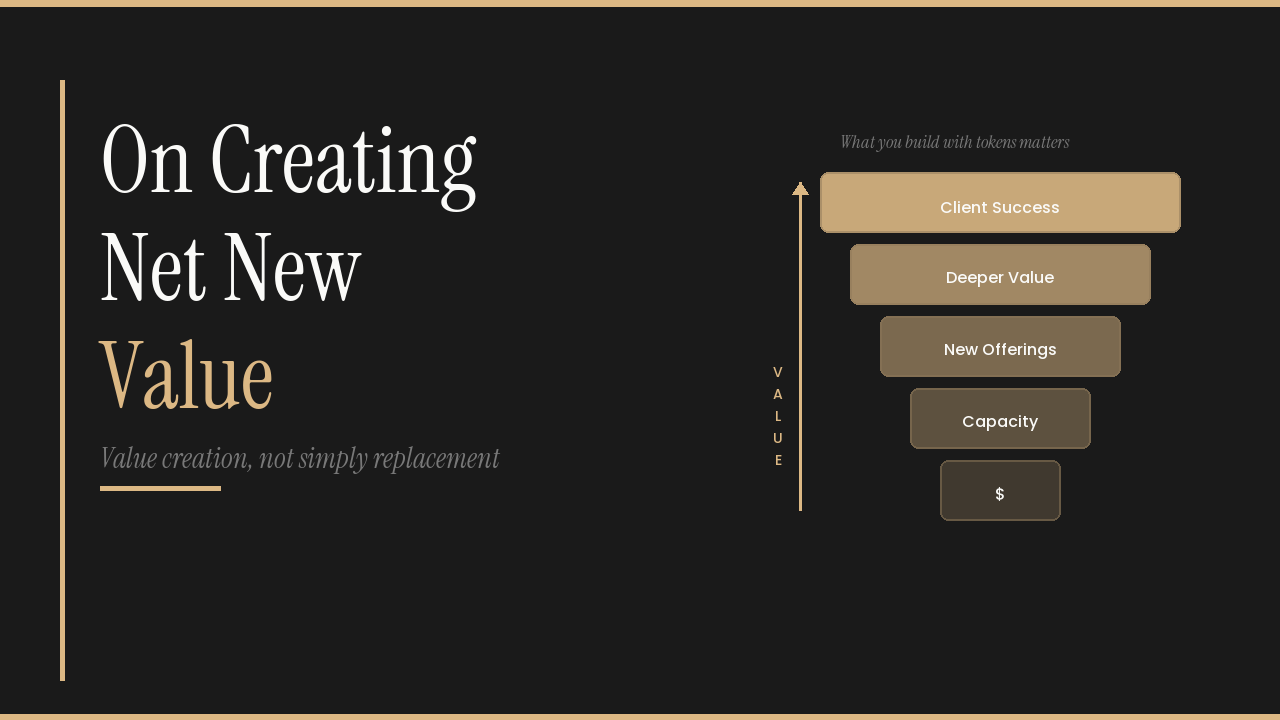
Find ways to increase your client lifetime value, your stickiness rate, reduce churn, increase your margins, or create new pricing opportunities that you couldn’t have accessed in the past. In my opinion, investing is the right reframe here.
Because if token costs are going to go down, the question isn’t “are tokens too expensive today?”
The real question is what are you building with those tokens that creates value which didn’t exist before, or that you couldn’t execute on before?
That’s what I call net new value.
What Net New Value Actually Is
So here’s what I mean by net new value: it’s the ability to do things that you previously couldn’t because it didn’t exist in your business or you didn’t have the capability to do so.
Not because you lacked ideas or because you didn’t know what to build. You were probably just stuck in execution, and when you’re stuck in execution, you lack innovation.
Even one of my clients literally told me that they need to get out of execution for the majority of their work so they can focus on higher level strategy, higher level relationship building, and higher level innovation.
And every single agency founder and consultant I work with has their version of this problem.
They know what they should be building, they know what the next offer could be, they know what they could be creating for their clients, but they just don’t have the time to do it, or it costs too much to add more value, and they can’t justify price increases with current clients on large contracts and retainers.
Most often it’s really that they’re stuck in the day to day, and that’s eating the ideation that could become new value.
So here’s the distinction I’m making:
net new value isn’t about doing the same work faster because that’s just efficiency.
It’s about creating new valuable offerings or helping a client go further than they could go without your support.
It’s about unlocking capacity from execution and deploying that capacity into creation.
This is worth repeating:
Net New Value is about unlocking capacity from execution and deploying that capacity into creation.
And going back to what I told my son, money is made by creating something valuable for someone else, and AI doesn’t change that principle. AI just gives you the capacity to reach and help clients get more value that they couldn’t otherwise access before.
So if you’re a founder spending 80% of your week on execution and 20% on strategy, you can now flip that ratio. I mean, it may not be completely a flip, but you can have more time for strategy and less time on execution.
And what comes out of that flip isn’t just more free time, although more free time is nice. It’s new products, new services, new ways of solving problems for clients that you literally could not offer before because you didn’t have the bandwidth to build them.
I don’t mean to be blunt, but if you can’t point to something specific you’re building, delivering, or offering that didn’t exist before you deployed agentic workflows, you’re probably still in replacement mode.
And replacement mode just looks at the math of token costs and focuses on efficiency.
We’re looking for more than efficiency here.
What This Looks Like in Practice
I’ll share a little bit of what I’m doing in my own practice because I can share with more openness than I can with my private clients.
The go to market work I do, full scope of research, signal detection, business case development, lead generation, and outreach strategy, could take anywhere from 4 to 8, maybe even up to 12 weeks to deploy from scratch.
Not because it’s inefficient, but because that’s how long this work actually takes when you’re doing it right.
Understanding positioning, buyer’s journey, signals indicating which companies or accounts are open or ready to buy, and the infrastructure to act on all of this does take time to build.
Now with agentic workflows supporting me on the execution layer, I can deliver that same depth of work in under a month.
But I’m not outsourcing my thinking.
I’m condensing time and getting to value quicker by having agents leverage all the capacity, the skill sets, and the learnings I’ve built through years of doing this work.
The compression doesn’t replace anyone.
What it does is allow me to focus on the 3 things that actually support my premium clients: strategy, relationship, and transformation.
The research still gets done, the signals get detected, the leads get qualified, but I’m spending my time on things that actually move the needle to help transform a client’s business rather than staying in the weeds of the doing.
And because I have the capacity back, I’m able to build new offerings, go deeper, and I mean much deeper, with existing clients and support high level engagements that I physically couldn’t have taken on before.
That’s the net new value part. It’s not the compression. It’s what I did with the space the compression created.
I don’t look at tokens or compute as an expense.
I’m looking at it as investing in the future of my firm and supporting my clients to go further.
And I’m watching this play out with someone I know who’s building what I’d call the firm of the future.
From the outside, this co-founder runs what looks like a software firm, but their delivery is 70% agentic. And because of their positioning, they work with high end elite clientele. The last 30% of their delivery has to be human every time, and that’s beautiful. That 30% is where the relationship lives.
The handoff, the last touch, the judgment call, none of that is something agents can replace because their positioning is focused on elite clients who expect the human aspect. They don’t expect to figure it all out on their own and just use software as a service. They expect that luxury feel.
And that’s a principle I learned from one of my clients in luxury:
If your client has to think, you’re failing.
Sit with that for a second when you think about how you’re creating net new value.
Going back to the 70/30 example, the net new value literally comes through their positioning. The agents handle the volume and delivery while the human handles the experience.
And because their business model targets higher end clients, they can do this. If they were at different price points or focused on a different market entirely, they’d probably have to compete on volume and just focus on automated delivery.
This goes back to your business model and your strategy.
Once you start thinking about net new value creation, how is your positioning in alignment with the services you deliver, in alignment with the value you create, in alignment with how you want to mix agentic work with human touch?
How to Find Your Net New Value (Start Here)
If this is interesting to you, here’s how I walk my clients through it, and this is the work I do every day.
It always starts with your current offerings because your offer actually dictates your positioning, it dictates your operations, your profitability, your business model, and your strategy.
Your offer literally is everything right now in your business.
So start here: what are you currently solving for?
Not “we do marketing.”
Not “we do consulting.”
Not “we build websites.”
What is the NUMBER ONE thing you’re solving for and what outcomes does that lead to?
Now look at the execution to deliver those outcomes.
Where’s the most manual effort? That’s the first place you can deploy agent support.
But once you deploy that support, you get some breathing room, and this is where the real work begins.
Now that you have capacity to focus on higher level thinking, what can you do for your clients that you couldn’t do before?
I’ll give you an analogous example.
One of the things I learned from spending millions in direct response advertising is that the best upsells aren’t manufactured, they’re natural.
When someone takes an action to solve their problem, whether they’re buying a product or downloading an ebook, they’re closing a loop in their mind even though they haven’t actually solved the problem yet. They took action towards it, and that feels good. It probably releases some sort of dopamine or rush.
Now when we would position upsells, we’d position the backend offer around a new problem that naturally surfaces after they solved the initial one in their mind. But you can’t solve that backend problem if you haven’t solved the front end problem first. In other words, they couldn’t see the value in the next offer if their initial problem was still consuming all of their attention.
The best next offer solves the new problem.
So when you work with clients, what is the outcome of that work? What does it solve for? And when you solve that, let’s future pace for a second.
When you solve that, what are the new opportunities that you can help your clients achieve? Or the new problems they’ll face? You don’t have to take on all the opportunities, but if you were me, I would look at those and identify which ones you should take on, which ones you’re excited to take on, or which ones you can build agentic workflows to support.
Because then you’re going beyond just selling a product or service. You’re helping your clients get to end state, goal accomplished, as far as you can take them.
And in my opinion, the company that can help clients go further will win this agentic era.
Go further up the value chain, deepen the relationship, increase your client’s likelihood of success, and actually help them see it through to the end outcome.
Marry that to your domain expertise and to the principles that will always exist in every business, revenue, margins, retention, lifetime value, and you have a model for net new value and the next layer of value creation.
Be a Creator & Inventor
Now to close, I will tell you to be a creator and an inventor. My son doesn’t even know what agentic workflows or tokens are. He doesn’t care about the arguments we’re having online. But I think he understands a principle in business at 4 years old that would be wise for all of us to adopt.
If you create something valuable, you can exchange it for a reward.
That’s it.
Most agencies and consultants I’m talking to aren’t struggling because they lack ideas. They mostly lack capacity, or a way to reinvigorate their energy towards ingenuity and innovation.
So leverage agentic workflows to give yourself capacity back, and use that capacity to become a creator, an innovator, to invent new ways and new opportunities to help your clients go further.
Don’t focus on using these tools just as replacement, because replacement is going to come. But that’s level zero thinking. We want to go beyond that and identify the new layer of value you can create.
And in my opinion, that’s how money has been made, and that’s how money will continue to be made. And for you to enjoy those profits and redistribute them with your teams and your family and your community so that you can thrive and ideally have fun with it.
Tinker, create, build, see what you can solve for. And then work doesn’t become work. It literally becomes play.
Create new value:
Focus on the human dignity at the center and how you’re helping other people accelerate
Leverage the tools to go beyond replacement
And as you create something valuable, you can exchange that and get rewarded for it
If you’re thinking about how to create net new value, or you’ve already created it and need support on how to repackage or reprice it, reach out.
These are things I absolutely love talking about and work with my clients on every day, and I’d love to see how I can support you.
Do Good Work,
Raul
It’s said that the average person impacts over 10,000 people in their lifetime. Know someone who might benefit from this post? Consider sharing it with them. You never know how you might be a positive influence in their life.
Did someone forward this to you? They must care about your success! You can subscribe to future posts here:
Designed with care from San Diego, handcrafted at the same location, and sent out unfiltered. There is little review process, no approval committee, and certainly no over contemplation. I write, get my points across, and hit send. Therefore, there will be grammatical issues and/or typos (yes, even with AI assistants).
If this is your first time here:
Hi 👋🏼 I’m Raul, I help service founders redesign how they price, sell, and operate in the agentic AI era.
When you’re ready to build the next version of your firm, let’s talk
Are we connected on LinkedIn? Let’s put a face to the name and connect! Drop me a note that you read the newsletter.